
Curriculum For Foundation 1 and 2
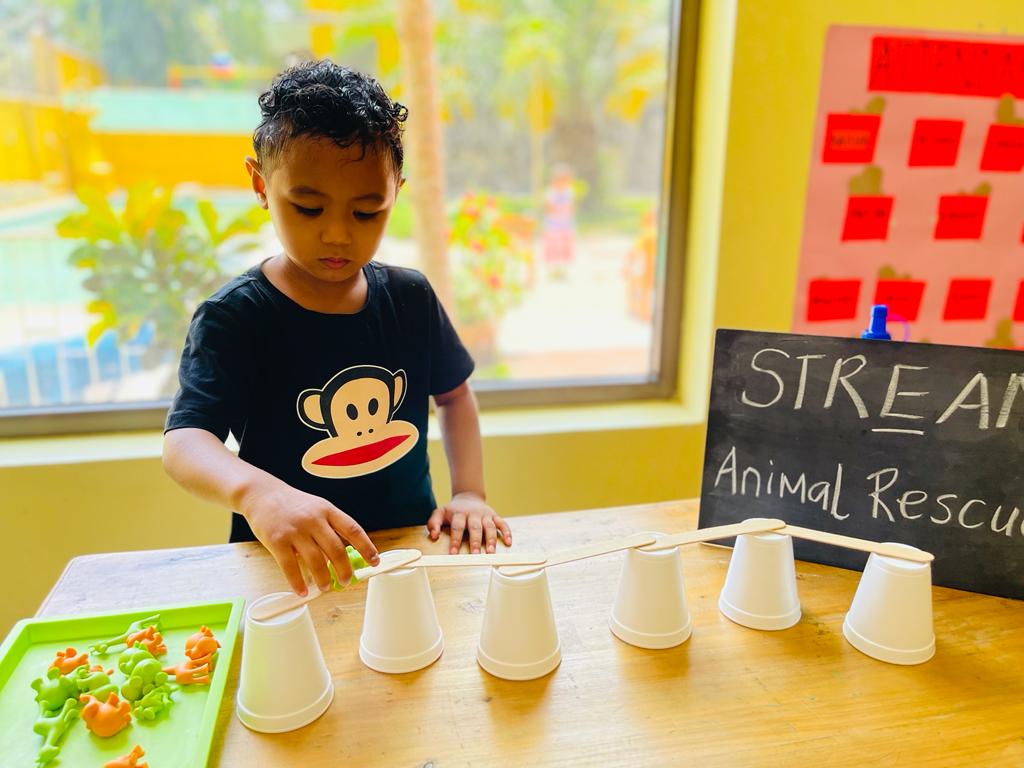
STREAM – a holistic approach
Framework
Mathematical Development:
Relates to using ideas about number, quantity, measurement, pattern, shape and space.
Communication, Language & Literacy:
Communication with one another and developing skills in talking, listening, writing and reading.
Knowledge & Understanding of The World:
Investigating and beginning to understand the things, places and people around them.
Personal, Social & Emotional Development:
Developing confidence and independence while learning to concentrate and to enjoy sharing as part of a group.
Creative Development:
Finding ways to communicate by using color, shape, sound, texture, movement and stories.
Physical Development:
Relates to improving control and coordination of their bodies while learning to move and handle equipment.
Description
Our curriculum allows preschoolers (3-6 years) to:
- Be confident to try new activities, initiate ideas and speak in a familiar group.
- Respond to significant experiences, showing a range of feelings when appropriate.
- Have a developing awareness of their own needs, views and feelings, and be sensitive to the needs, views and feelings of others.
- Have a developing respect for their own cultures and beliefs and those of other people.
- Form good relationships with adults and peers.
- Work as part of a group or class, taking turns and sharing fairly, understanding that there needs to be agreed values and codes of behavior for groups of people, including adults and children, to work together harmoniously.
- Consider the consequences of their words and actions for themselves and others.
- Select and use activities and resources independently.
- Express and communicate their ideas, thoughts and feelings by using a widening range of materials, imaginative and role-play, movement, designing and making Interact with others, negotiating plans and activities and taking turns in conversation.
Language skills:
- Enjoy listening to and using spoken and written language, and readily turn to it in their play and learning.
- Sustain attentive listening, responding to what they have heard with relevant comments, questions or actions.
- Extend their vocabulary, exploring the meanings and sounds of new words.
- Speak clearly and audibly with confidence and control and show awareness of the listener.
- Use language to imagine and recreate roles and experiences.
- Use talk to organise, sequence and clarify thinking, ideas, feelings and events.
- Learn the phonetic sounds, blend, read and write Interact with others, negotiating plans and activities and taking turns in conversation.
Numeracy skills:
- Use developing mathematical ideas and methods to solve practical problems.
- Investigate objects and materials by using all of their senses as appropriate.
- Ask questions about why things happen and how things work.
- Build and construct with a wide range of objects, selecting appropriate resources and adapting their work where necessary.
- Select the tools and techniques they need to shape, assemble and join materials they are using.
Cognitive skills:
- Find out about and identify the uses of everyday technology and use information and communication.
- Observe, find out about and identify features in the place they live and the natural world.
- Show awareness of space, of themselves and of others.
- Use a range of small and large equipment.